
Gastric Bypass vs Sleeve Gastrectomy: Which Is Better for YOU? 2026
Talk to our team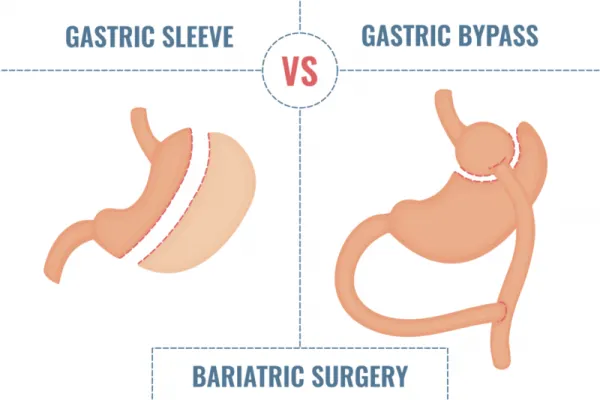
In this article 18 sections
Gastric bypass and sleeve gastrectomy are the two most performed bariatric operations in the world — together accounting for over 80% of all weight loss surgeries. Both produce dramatic, life-changing results. Both are laparoscopic. Both work. But they work differently, have different risk profiles, and suit different patients. The question is not which procedure is "better" in the abstract — it is which one is right for your specific situation. This guide gives you an honest, evidence-based answer for gastric bypass vs sleeve gastrectomy.
| You have severe Type 2 diabetes | → Gastric bypass (80% diabetes remission vs 60% for sleeve) |
| You have severe acid reflux / GERD | → Gastric bypass (sleeve can worsen reflux) |
| You want a simpler, lower-risk procedure | → Gastric sleeve (3% vs 5% complication rate) |
| You take daily medications you must absorb | → Gastric sleeve (bypass alters absorption) |
| You want maximum long-term weight loss | → Gastric bypass (10–25 lbs more at 5 years) |
| This is your first bariatric surgery | → Usually sleeve first — bypass if needed later |
How each procedure works — the fundamental difference
The surgeon removes approximately 80% of the stomach permanently, leaving a banana-shaped "sleeve." The stomach is smaller — you eat less, feel full faster, and crucially, the removed portion includes the cells that produce ghrelin (the hunger hormone). Result: you eat less AND feel less hungry.
- Restriction only — no intestinal rerouting
- Stomach volume: 80–100ml (was ~1,000ml)
- Ghrelin production reduced by ~70%
- Digestion pathway unchanged
- Reversible? No. But convertible to bypass.
The surgeon creates a small gastric pouch (about 30ml) from the top of the stomach, then reroutes the small intestine so food bypasses 90–95% of the original stomach and the first section of the small intestine. Result: restriction + reduced calorie/fat absorption + powerful hormonal changes.
- Restriction + malabsorption combined
- Pouch volume: ~30ml
- Bypasses 90–95% of stomach
- Intestinal rerouting — two anastomoses
- More complex surgery. More metabolic impact.
Head-to-head comparison — all the numbers
| Factor | 🔵 Gastric Sleeve | 🟠 Gastric Bypass | Winner |
|---|---|---|---|
| Excess weight loss (1 year) | 60–70% | 65–80% | 🟠 Bypass (slight edge) |
| Excess weight loss (5 years) | 50–70% | 65–80% | 🟠 Bypass (+10–25 lbs) |
| Type 2 diabetes remission | 55–65% | 75–85% | 🟠 Bypass (significantly) |
| Hypertension improvement | 60–75% | 75–85% | 🟠 Bypass |
| Sleep apnoea improvement | 60–80% | 80–85% | 🟠 Bypass |
| Overall complication rate | 3% | 5% | 🔵 Sleeve (safer) |
| GERD / acid reflux after surgery | Can worsen significantly | Usually improves | 🟠 Bypass (critical point) |
| Nutritional deficiency risk | Lower | Higher (malabsorption) | 🔵 Sleeve |
| Surgical complexity | Simpler — 1 surgical step | More complex — 2 anastomoses | 🔵 Sleeve |
| Hospital stay | 1–2 days | 2–3 days | 🔵 Sleeve |
| Recovery to normal activity | 3–4 weeks | 4–6 weeks | 🔵 Sleeve |
| Cost — Turkey (all-inclusive) | €3,000–€4,500 | €4,000–€5,500 | 🔵 Sleeve |
| Reversibility | No — but convertible to bypass | No | ⚖️ Equal |
| Dumping syndrome risk | Rare | 10–20% of patients | 🔵 Sleeve |
Which is right for YOU? — decision by patient type
This is the section no other bariatric comparison guide gives you: a clear, honest recommendation based on your specific health profile. These are clinical guidelines, not absolute rules — your surgeon makes the final assessment. But this is what the evidence shows.
Choose gastric bypass if you have Type 2 diabetes
The reason: gastric bypass creates immediate changes in gut hormone signalling — particularly GLP-1 and GIP — that improve insulin sensitivity independently of weight loss. This is why many diabetic patients see blood glucose normalise within days of bypass surgery, before they have lost significant weight. See: Diabetes and Bariatric Surgery Guide →
Choose gastric bypass if you have severe GERD / acid reflux
Choose gastric sleeve if you want a simpler, lower-risk procedure
Gastric sleeve has an overall complication rate of approximately 3%, compared to approximately 5% for gastric bypass. While both are statistically very safe (obesity itself carries far greater long-term health risks than either surgery), the sleeve's single surgical step (stomach removal, no intestinal rerouting) is technically simpler, has fewer potential failure points, and carries lower risk of serious complications including anastomotic leak and internal hernia.
For patients who are older, have multiple comorbidities, or have higher surgical risk on preoperative assessment — sleeve gastrectomy is typically preferred as the lower-risk path to effective weight loss.
Choose gastric sleeve if you take medications you must absorb fully
Gastric bypass significantly alters medication absorption — some drugs are absorbed faster (reaching toxic levels), some are absorbed less completely (becoming ineffective). This is a critical consideration for patients on:
- Immunosuppressants (transplant patients)
- Anticoagulants (blood thinners)
- Thyroid medications
- Psychiatric medications where stable blood levels are critical
- Contraceptives (particularly oral pill — absorption unreliable after bypass)
Gastric sleeve does not affect medication absorption, as the digestive pathway is unchanged.
Choose gastric bypass for maximum long-term weight loss
If your BMI is very high (above 50) or you have significant weight to lose and metabolic health is heavily compromised, bypass typically produces better long-term outcomes. Studies show bypass patients lose an average of 10–25 additional pounds compared to sleeve patients at the 5-year mark, with higher rates of sustained weight loss maintenance. The combination of restriction, malabsorption, and more powerful hormonal changes produces a more potent metabolic effect.
Sleeve first, bypass later — the staged approach
For very high-BMI patients (BMI above 60) or those with significant surgical risk, many bariatric surgeons recommend sleeve gastrectomy as a first stage, followed by conversion to bypass 12–18 months later. The sleeve reduces body weight and surgical risk; the subsequent bypass provides maximum metabolic benefit once the patient is at a safer surgical weight. This two-stage approach is standard practice for very high-risk cases.
Weight loss trajectory — what to realistically expect
| Timepoint | Gastric Sleeve | Gastric Bypass | What's happening |
|---|---|---|---|
| 1 month | 10–15% EWL | 15–20% EWL | Liquid diet. Rapid initial loss. |
| 3 months | 30–40% EWL | 35–45% EWL | Fastest loss phase. Normal eating resuming. |
| 6 months | 50–60% EWL | 55–65% EWL | Most patients return to work and normal activity. |
| 12 months | 60–70% EWL | 65–80% EWL | Most weight loss complete. |
| 5 years | 50–70% EWL | 65–80% EWL | Some regain normal. Bypass maintains better long-term. |
EWL = Excess Weight Loss. Example: 100kg overweight patient, 50% EWL = 50kg lost. Results depend heavily on adherence to dietary and lifestyle guidance post-surgery.
Risks — the honest comparison
- Staple line leak — 0.7–1.5%. The most serious early complication.
- Stricture — narrowing of the sleeve. Can require dilation.
- GERD worsening — significant risk, especially in those with pre-existing reflux. Can require conversion to bypass.
- Nutritional deficiency — lower risk than bypass but supplementation still required
- Weight regain — sleeve can stretch over time if capacity is exceeded repeatedly
- Anastomotic leak — 0.5–2%. More failure points than sleeve.
- Internal hernia — 2–5% lifetime risk from bowel rerouting
- Dumping syndrome — rapid gastric emptying causing nausea, sweating; 10–20% of patients
- Nutritional deficiency — higher risk. B12, iron, calcium, D3 must be supplemented lifelong
- Hypoglycaemia — late dumping syndrome causing blood sugar drops
- Marginal ulcer — at the anastomosis site; higher risk in smokers
Cost comparison — Turkey vs UK vs USA
| Country | Gastric Sleeve | Gastric Bypass |
|---|---|---|
| 🇹🇷 Turkey — Antalya (all-incl.) | €3,000 – €4,500 | €4,000 – €5,500 |
| 🇬🇧 UK (private) | £10,000 – £15,000 | £14,000 – £20,000 |
| 🇺🇸 USA (private) | $15,000 – $25,000 | $20,000 – $35,000 |
| 🇩🇪 Germany (private) | €10,000 – €15,000 | €13,000 – €18,000 |
| 🇦🇺 Australia (private) | AUD 15,000 – 22,000 | AUD 20,000 – 30,000 |
For detailed Turkey cost guides: Gastric Sleeve Cost Turkey → | Gastric Bypass Cost Turkey →
The 7-question checklist — which surgery fits your profile?
Answer these 7 questions — your answers point toward the right procedure
| Question | If YES |
|---|---|
| 1. Do you have Type 2 diabetes requiring insulin? | → Strongly consider Bypass |
| 2. Do you have frequent acid reflux or GERD? | → Strongly consider Bypass |
| 3. Are you on medications that require precise absorption? | → Strongly consider Sleeve |
| 4. Is this your first weight loss surgery? | → Often Sleeve first |
| 5. Is your BMI above 50 or you have very high excess weight? | → Bypass may be more effective |
| 6. Are you concerned about long-term vitamin supplementation? | → Sleeve (lower deficiency risk) |
| 7. Do you have a strong personal or family history of osteoporosis? | → Sleeve (bypass reduces calcium absorption) |
This checklist is a decision aid, not a medical recommendation. A bariatric surgeon evaluates your full medical history before recommending a procedure.
What happens to common conditions after each surgery
| Condition | Gastric Sleeve | Gastric Bypass |
|---|---|---|
| Type 2 diabetes | Remission in 55–65% | Remission in 75–85% ★ |
| Hypertension | Resolves in 60–75% | Resolves in 75–85% ★ |
| Sleep apnoea | Improves in 60–80% | Improves in 80–85% ★ |
| Acid reflux / GERD | Can worsen — 20–30% | Usually improves ★ |
| High cholesterol | Improves in 70% | Improves in 80% ★ |
| Joint pain (knees, hips) | Significant improvement | Significant improvement |
| Iron / B12 deficiency | Lower risk | Higher risk — lifelong supplementation |
What about mini gastric bypass (OAGB)?
A third option has grown in popularity: the one-anastomosis gastric bypass (OAGB), also called mini gastric bypass. It creates a longer narrow gastric pouch and connects it to the small bowel in a single anastomosis (versus two in Roux-en-Y).
It is faster to perform, produces weight loss comparable to Roux-en-Y bypass, and has only one connection point. It is now the third most performed bariatric procedure globally. Ask your bariatric surgeon whether OAGB is appropriate for your case — it may offer the metabolic benefits of bypass with slightly lower surgical complexity.
Bariatric surgery Turkey — why patients choose us
Both gastric sleeve and gastric bypass in Turkey cost 70–80% less than in the UK or USA — for the same laparoscopic procedure, the same surgical technique, and comparable surgeon training. The difference is clinic overhead and healthcare delivery cost, not quality.

At The More Clinics in Antalya, our bariatric team performs both gastric sleeve and gastric bypass laparoscopically. Each patient receives a pre-operative assessment including blood work, cardiology clearance, sleep study review, and nutritional consultation before any surgery recommendation is made. We do not recommend bypass when sleeve is appropriate — and vice versa. Explore our dedicated procedure pages:
Gastric Sleeve Turkey → Gastric Bypass Turkey → Gastric Bypass in Turkey — Full Guide → Not ready for surgery? Gastric Balloon →
Frequently asked questions - Gastric Sleeve vs Bypass
Is gastric bypass better than sleeve gastrectomy?
In terms of raw weight loss and metabolic disease resolution (diabetes, hypertension, cholesterol), gastric bypass produces somewhat better outcomes than sleeve gastrectomy. At 5 years, bypass patients have typically lost 10–25 lbs more than sleeve patients.
However, bypass carries a higher complication rate (5% vs 3%), higher nutritional deficiency risk, and the critical disadvantage of worsening acid reflux in many patients. For patients without severe diabetes or reflux who want a lower-risk procedure, sleeve is often the better individual choice. The answer depends entirely on your specific health profile.
Which surgery has less risk — bypass or sleeve?
Gastric sleeve has a lower overall complication rate (approximately 3% vs 5% for bypass). Both are considered extremely safe operations — safer, statistically, than leaving severe obesity untreated. The additional risk in bypass comes from its greater surgical complexity (two intestinal anastomoses versus none in sleeve) and the potential for internal hernia as a late complication. For patients with elevated surgical risk, sleeve is generally preferred.
Can I get gastric sleeve now and bypass later?
Yes — sleeve gastrectomy can be converted to Roux-en-Y gastric bypass in a subsequent operation if sleeve is insufficient (inadequate weight loss, or if GERD develops after sleeve and becomes severe). This staged approach is planned from the outset in some very high-BMI patients. Conversion from sleeve to bypass is a more complex operation than primary bypass but is a well-established procedure.
Which surgery is best for diabetes?
Gastric bypass (Roux-en-Y) produces significantly higher rates of Type 2 diabetes remission than sleeve gastrectomy — 75–85% versus 55–65%. The metabolic effect of intestinal rerouting on gut hormone signalling produces rapid blood glucose normalisation, often within days of surgery, before significant weight loss has occurred. For any patient whose primary goal is diabetes remission or significant reduction in insulin requirements, bypass is the stronger clinical recommendation.
How much does gastric bypass vs sleeve cost in Turkey?
In Turkey (Antalya, all-inclusive with hotel and transfers): Gastric sleeve €3,000–€4,500. Gastric bypass €4,000–€5,500. UK comparison: sleeve £10,000–£15,000, bypass £14,000–£20,000. The cost difference between the two procedures exists because bypass is more complex surgery requiring more operating time. Both are considerably less expensive in Turkey than in the UK, USA, or Germany. Full cost details: Gastric Sleeve Cost | Gastric Bypass Cost
What is dumping syndrome and who gets it?
Dumping syndrome occurs when food moves too rapidly from the stomach into the small intestine. After bypass, the small gastric pouch allows food — particularly high-sugar or high-fat food — to pass quickly to the small bowel, triggering symptoms: nausea, sweating, flushing, abdominal cramps, and diarrhoea within 15–30 minutes of eating (early dumping) or hypoglycaemia 1–3 hours later (late dumping).
Approximately 10–20% of bypass patients experience significant dumping syndrome. Sleeve patients rarely experience it, as the pylorus (stomach valve) is preserved. Dumping syndrome can usually be managed by avoiding sugary and fatty foods, eating small portions slowly, and not drinking with meals.
Should I read about myths before deciding gastric sleeve vs bypass?
Yes — there are many misconceptions about both surgeries. See: Common Myths About Gastric Sleeve Explained →
The Last Word from The More Clinics
Gastric bypass vs gastric sleeve are not competing procedures — they are complementary tools, each suited to a different patient profile. The question is never "which surgery is better" in the abstract. The question is: which surgery is better for your BMI, your health conditions, your medications, your risk tolerance, and your long-term goals? That question has a specific answer for every patient — and getting it right from the start saves years of suboptimal results or the need for revision.
Bariatric team at The More Clinics makes this recommendation based on your complete pre-operative assessment — not on which procedure is more profitable or more commonly booked. A free WhatsApp consultation with your current weight, height, health conditions, and any blood test results gives us everything we need to tell you honestly which procedure is the right fit for your situation.
Get a Free Consultation → WhatsApp Us →
Medical disclaimer: This comparison guide is for informational and educational purposes only and does not constitute medical advice. Bariatric surgery recommendations depend on individual clinical assessment. Consult a qualified bariatric surgeon before making any surgical decision.
This article is medically reviewed by Dr. Namık Yılmaz, General Surgeon and Bariatric Surgeon
This article provides general information and does not replace an individual medical assessment, diagnosis or treatment advice. Discuss decisions about your health and treatment with your treating clinician.