Dental Crown Aftercare: Complete Care Guide 2026
Talk to our team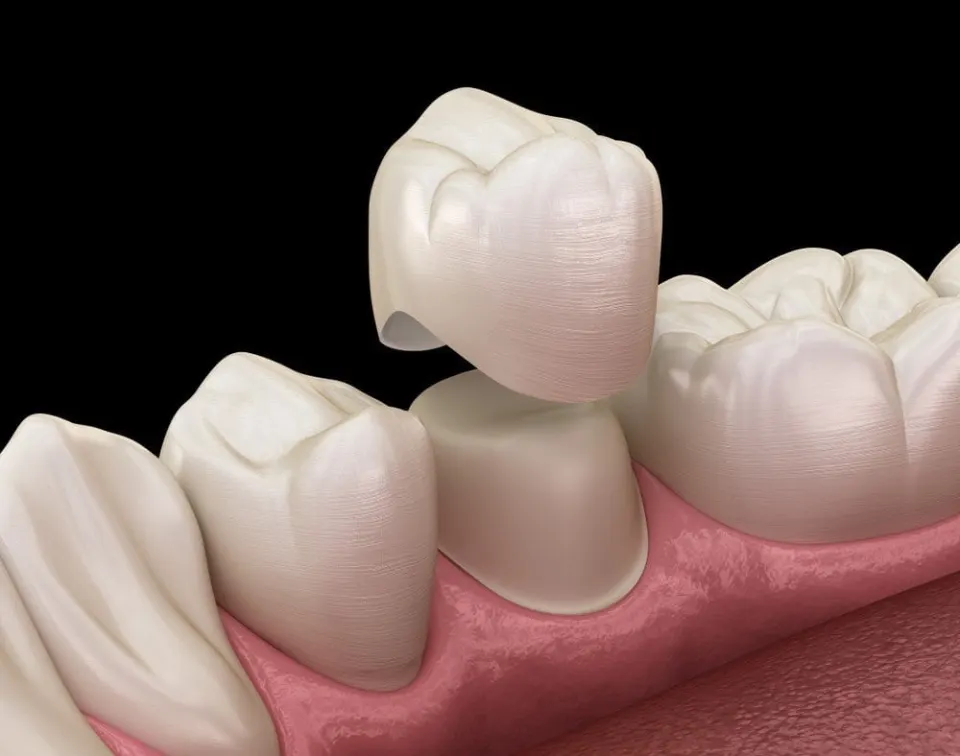
In this article 22 sections
Dental crowns are one of the most durable restorations in dentistry — a well-made zirconia or E-Max crown can last 15–25 years. Whether that lifespan is achieved depends almost entirely on how you care for it. This guide covers everything: the first 24 hours after crown placement, temporary crown care, long-term daily habits, what to eat and avoid, how to clean around a crown, recognising warning signs, and when to call your dentist.
| How long does sensitivity last after a crown? | Typically 2–4 weeks. Fading = normal. Worsening = see dentist. |
| Can you eat normally with a crown? | Yes — avoid hard, very sticky and extremely hot/cold foods |
| Can you brush a dental crown? | Yes — twice daily, soft brush, normal fluoride toothpaste |
| How long do dental crowns last? | Zirconia: 15–25 yrs. E-Max: 15–20 yrs. PFM: 10–15 yrs. |
| Crown fell off — what to do? | Keep it. Call dentist same day. Do not glue it yourself. |
| Temporary vs permanent crown care | Temporary: more restrictions. Permanent: normal care applies. |
First 24 hours after crown placement
The first 24 hours are the most critical for a newly placed crown. The cement that holds the crown needs time to fully set, and the surrounding gum tissue is still recovering from the procedure.
| Timing | Do | Avoid |
|---|---|---|
| First 1–2 hours | Wait for anaesthesia to fully wear off before eating | All food and drink — risk of biting cheek, tongue, burning mouth |
| Hours 2–24 | Soft foods only. Chew on opposite side if possible. Gentle salt water rinse. | Hard, crunchy, sticky or chewy foods. Very hot or very cold drinks. Vigorous rinsing. |
| Day 1 evening | Gentle brushing around crown. Normal flossing — slide out sideways, don't snap. | Whitening toothpaste, abrasive products, mouthwash with alcohol. |
Temporary crown aftercare
Temporary crowns serve as placeholders while your permanent crown is being fabricated in the laboratory. They are made from acrylic and held with temporary cement — by design less secure than permanent crowns. Full temporary crown guide →
- Brush gently twice daily
- Floss daily — slide out sideways
- Eat soft foods on opposite side
- Rinse with warm salt water
- Call dentist if it comes off
- Sticky foods — chewing gum, toffee, caramel
- Hard foods — nuts, raw carrots, crusty bread
- Snapping floss up through — pulls crown off
- Very hot or very cold food and drinks
- Whitening toothpaste
If your temporary crown comes off: keep it, call your dentist the same day, and avoid eating on that side. Do not try to re-cement it yourself with household glue. If you cannot reach your dentist quickly, temporary crown cement (available at pharmacies) can hold it in place until your appointment — but professional re-cementing is required.
What to eat after a dental crown
Once your permanent crown is placed and fully cemented, you can eat normally — with a few permanent restrictions that apply for the crown's entire lifespan, not just the recovery period.
First week — soft foods recommended
| Safe to eat | Avoid for first week |
|---|---|
| Yoghurt, soft cheese, eggs | Ice, hard candy, crusty bread |
| Pasta, rice, soft-cooked vegetables | Chewing gum, toffee, sticky sweets |
| Soft fish, chicken, mashed potato | Raw carrots, apples (bite), nuts |
| Soup (lukewarm), smoothies, yoghurt | Very hot drinks, ice-cold drinks |
| Soft fruit — banana, melon, berries | Anything requiring biting directly into the crown |
Permanently avoid — applies to all crown types for life
- Ice chewing — the single most common cause of crown fracture. Even zirconia can crack under the point load of biting hard ice.
- Very sticky foods — toffee, caramel, some chewing gums can pull the crown off the underlying tooth, especially if the crown is older.
- Biting hard objects — fingernails, pen caps, bottle tops, hard seeds. These create extreme point loading that crowns are not designed to withstand.
- Opening packaging with teeth — a surprisingly common way crowns (and natural teeth) fracture.
Staining foods and crown appearance
Zirconia and E-Max crowns are highly stain-resistant — coffee, tea and red wine are unlikely to stain the crown itself. However, staining can still occur at the cement line where crown meets tooth. Porcelain-fused-to-metal (PFM) crowns are more susceptible to staining at the porcelain margin. Limit red wine, coffee, and dark sauces if maintaining maximum whiteness is a priority, and use a low-abrasion toothpaste rather than a whitening formula. For crown types and material detail: Types of Dental Crowns 2026 →
How to clean a dental crown
A crown cannot decay — but the tooth underneath it can. The most important area to clean is the crown margin: the line where the crown meets the tooth at the gum line. Bacteria accumulating here leads to secondary decay under the crown and gum inflammation.
Brushing
- Twice daily — morning and before bed
- Soft-bristled toothbrush — medium or hard bristles abrade the glaze on zirconia and E-Max crowns over time
- Fluoride toothpaste — non-whitening, non-abrasive. Whitening toothpastes contain micro-abrasives that dull crown surfaces over months.
- 45-degree angle at the gum line — direct bristles toward the crown margin, the critical area for bacteria control
- Electric toothbrush recommended — significantly more effective at removing plaque at the crown margin than manual brushing
Flossing
- Daily — flossing around a crown is more important than around a natural tooth because the margin is a vulnerable point
- Slide out sideways — never snap or pull floss upward through the contact. This can dislodge a crown, particularly a temporary one.
- Floss threaders — useful if the crown is part of a bridge where normal flossing is not possible
- Interdental brushes — effective for cleaning around crown margins where a regular toothbrush cannot reach
- Water flosser — an excellent supplement for flushing debris from around crown margins, particularly useful for patients with bridges or multiple adjacent crowns
Mouthwash
A fluoride mouthwash used once daily protects the natural tooth margins around the crown from secondary decay. Avoid mouthwashes with high alcohol content — they dry the oral mucosa and can, over time, slightly degrade some cement types. Chlorhexidine mouthwash is effective short-term (up to 4 weeks) if gum inflammation develops around a new crown, but is not recommended for long-term daily use.
Dental crown sensitivity — when is it normal?
Sensitivity after crown placement is extremely common. The tooth preparation process irritates the nerve, and the cement takes time to fully cure. The key distinction is between normal, fading sensitivity and sensitivity that signals a problem.
| Type | Duration | Action |
|---|---|---|
| Mild cold/heat sensitivity — fading | Up to 4 weeks ✓ | Desensitising toothpaste, monitor |
| Pain when biting — bite feels high | Any duration | Dentist adjustment — quick fix |
| Sensitivity persisting beyond 6 weeks | 6+ weeks | Dentist assessment — possible pulpitis |
| Throbbing or spontaneous pain | Any | Dentist this week — nerve involved |
| Pain at 6+ months after crown | Not normal | Dentist promptly — infection/decay possible |
For the complete guide on crown sensitivity including causes, types and treatment: Tooth Sensitivity After Crown — Full Guide →
Long-term crown care — habits that determine lifespan
A crown placed today can realistically last 20+ years. The habits that determine whether it does:
Night grinding (bruxism)
Bruxism is the most underestimated threat to crown longevity. The forces generated during grinding can be 6–10 times the normal chewing load — applied for hours every night. A custom night guard (occlusal splint) made by your dentist distributes these forces and prevents crown fracture. If you grind at night and have crowns — a night guard is not optional. Signs of bruxism: waking with jaw soreness, headaches, worn-looking teeth, your partner reports grinding sounds.
Regular dental check-ups
Every 6–12 months. The dentist checks: crown margins for secondary decay or cement failure, gum health around the crown, bite alignment, and the crown surface for wear or micro-fractures. Problems caught early are resolved with a quick repair or adjustment; problems missed until symptoms appear often require crown replacement. Gum disease around a crown is particularly important to catch early — bone loss causes the crown margin to be exposed, leading to root sensitivity and decay. Gingivitis Guide →
Gum health around crowns
Healthy gum tissue seals around the crown margin and protects the root surface below. When gum tissue recedes — from brushing too hard, from gum disease, or from ageing — the crown margin is exposed. This causes sensitivity and creates a gap where bacteria can cause secondary decay beneath the crown. Daily flossing at the crown margin is the single most effective preventive step for long-term gum health around a crown.
Avoid using crowned teeth as tools
Opening bags, bottles, or packaging with your teeth generates extreme lateral forces crowns are not designed to withstand. This applies to natural teeth too — but crowns are more vulnerable because the bond between crown and tooth is a potential failure point under shear forces.
How long do dental crowns last?
| Crown material | Expected lifespan | Main lifespan risk |
|---|---|---|
| Zirconia (monolithic) | 15–25+ years | Secondary decay at margin |
| E-Max (lithium disilicate) | 15–20 years | Fracture under heavy biting load |
| PFM (porcelain on metal) | 10–15 years | Porcelain chipping, grey margin |
| Full metal (gold alloy) | 20–30+ years | None — most durable of all types |
These are averages with proper care. With bruxism, poor oral hygiene, or very abrasive diet, lifespan can be significantly shorter. For crown types, material detail and cost comparison: Types of Dental Crowns & Cost 2026 →
Warning signs — when to call your dentist
| Symptom | Urgency | Likely cause |
|---|---|---|
| Mild cold sensitivity, first 2–4 weeks | No urgency | Normal post-procedure |
| Crown feels high — bite off | Within 1 week | High bite — quick adjustment |
| Sensitivity beyond 6 weeks | Within 2 weeks | Pulpitis or poor fit |
| Crown feels loose or rocks slightly | Within 1 week | Cement failure |
| Crown fell off completely | Same day | Keep crown, call dentist |
| Throbbing pain or pain at night | This week | Irreversible pulpitis or infection |
| Swelling or discharge at gum line | Same day | Abscess — potentially serious |
| Visible crack line across crown | Within 1 week | Crown fracture — replacement needed |
What to do if a dental crown falls off
A crown falling off is more common than most patients expect — particularly older crowns where cement has degraded over years. It is not immediately dangerous, but the exposed prepared tooth is vulnerable and needs prompt attention.
- Retrieve and keep the crown — rinse it gently with water, do not scrub. Keep it in a small container. Your dentist can often re-cement the original crown if it is intact and undamaged.
- Call your dentist the same day — most practices will fit you in for a same-day or next-day emergency appointment for a displaced crown.
- Protect the tooth in the meantime — if you cannot reach your dentist quickly, temporary dental cement (available over the counter at pharmacies) can hold the crown in place temporarily. Follow the package instructions.
- Do not use household adhesives — superglue, epoxy or other household products in your mouth are dangerous and can permanently damage the crown and the tooth. Professional dental cement is the only acceptable adhesive.
- Avoid eating on that side — the prepared tooth beneath is sensitive without its crown and is vulnerable to fracture under direct biting force.
If the crown cannot be re-cemented — because it is damaged, or the underlying tooth has decayed — a new crown will be needed. Your dentist assesses this at the appointment.
Dental crown care for international patients — returning home after treatment in Turkey
If your crowns were placed at The More Clinics in Antalya, your 12-month remote aftercare is built into every treatment package. You do not need a dentist in your home country for routine crown aftercare — your coordinator at The More Clinics is available by WhatsApp for any post-treatment concern, and can arrange a video assessment with your treating dentist, Dr. Onur Ademhan, for any clinical question.
For the first 4 weeks after returning home:
- Follow the first-week diet restrictions for 10–14 days
- Contact your coordinator immediately if you experience throbbing pain, swelling, or a crown comes off — do not wait for your next routine appointment
- Mild sensitivity and awareness of the crowns is normal — it fades as the bite settles
- Attend your 6-week check-up with a local dentist if possible — or send photographs to your coordinator for remote review
For everything about the crown treatment journey in Antalya: Dental Crowns Antalya — Complete Guide → | Dental Crown Before & After →
Frequently asked questions — dental crown aftercare
Do dental crowns need special care?
No special products are required — just consistent application of normal dental hygiene. Soft-bristled brush, fluoride toothpaste (non-abrasive), daily flossing with sideways exit at the crown margin, and a fluoride mouthwash. The difference from caring for natural teeth is the emphasis on the crown margin: this is where secondary decay can develop and where gum inflammation concentrates. Give this area slightly more attention when brushing and flossing.
Can you brush a dental crown normally?
Yes — twice daily with a soft-bristled brush and fluoride toothpaste. The crown surface itself cannot decay. Brush at a 45-degree angle toward the gum line to clean the margin area. Avoid whitening or abrasive toothpastes — these contain micro-abrasives that gradually dull the polished surface of zirconia and E-Max crowns, making them slightly more susceptible to staining over time.
What toothpaste is best for dental crowns?
A standard fluoride toothpaste — non-whitening, non-abrasive. Sensitivity toothpastes (containing potassium nitrate or stannous fluoride) are appropriate if you have post-crown sensitivity. Avoid baking soda-based or charcoal toothpastes — both are highly abrasive and damage crown glazes over time. No toothpaste whitens ceramic crowns — the shade is fixed at fabrication.
How long does sensitivity last after a dental crown?
Typically 2–4 weeks for mild temperature and pressure sensitivity. Most patients notice significant improvement between weeks 2 and 4. Sensitivity that worsens rather than improves, persists beyond 6–8 weeks, or is accompanied by throbbing or pain at night is not normal — see your dentist. For the full breakdown: Tooth Sensitivity After Crown Guide →
Can I eat the same day as crown placement?
Yes — but wait for the anaesthesia to wear off completely before eating (typically 1–2 hours). For the first 24 hours, stick to soft foods and avoid extreme temperatures, very sticky or very hard foods. After the first week, normal eating resumes with the permanent exceptions listed above.
How do I know if my crown needs replacing?
Your dentist assesses this at regular check-ups. Signs that suggest a crown may need replacement: visible crack lines across the crown surface, a dark line appearing at the gum margin (common with older PFM crowns as gums recede), persistent sensitivity that does not resolve with treatment, visible decay at the crown margin on X-ray, or the crown rocking or feeling loose. A well-made zirconia or E-Max crown with no margin decay and good gum health does not need replacement by age alone.
Can I whiten dental crowns?
No — ceramic crown materials (zirconia, E-Max, porcelain) do not respond to peroxide-based whitening agents. The shade of a crown is permanently fixed at fabrication. If your natural teeth change shade from whitening and your crowns no longer match, the crowns would need to be replaced to match the new shade. For this reason, if you plan to whiten your teeth, do so before crowns are made — the new crowns are then fabricated to match your whitened shade.
Is it normal for the gum around a new crown to be sore?
Yes — for the first 1–2 weeks. The gum tissue is recovering from the preparation process and the impression procedure. Gentle salt water rinsing (½ tsp salt in warm water, 30 seconds, 3x daily) reduces inflammation. Continued gum soreness beyond 2 weeks, or gum swelling with a whitish or reddish discharge, should be assessed by your dentist — it may indicate gum inflammation at the crown margin or, rarely, early infection.
The Last Word from The More Clinics
A dental crown is an investment in your tooth — and like any investment, what you get from it over time depends on how you manage it. The habits that make the biggest difference are not complicated: daily flossing at the crown margin, avoiding hard and sticky foods, wearing a night guard if you grind, and attending check-ups. A crown placed with precision in good oral health, and maintained with consistent daily care, should last 15–25 years without issue.
If your crowns were placed at The More Clinics, your coordinator is your first point of contact for any post-treatment concern — available by WhatsApp throughout your 12-month aftercare period. We are here for the full journey, not just the treatment.
Contact Your Coordinator → WhatsApp Us →
Medical disclaimer: This guide is for informational and educational purposes only. Post-crown care varies by individual clinical situation. Contact your treating dentist for guidance specific to your case.
This article provides general information and does not replace an individual medical assessment, diagnosis or treatment advice. Discuss decisions about your health and treatment with your treating clinician.