Tooth Chart: Universal Tooth Numbering Charts
Talk to our team
In this article 10 sections
Effective communication among dental professionals is crucial for accurate dental records, treatment plans, and collaboration. By understanding the dental naming system and teeth numbering, you can gain insights into the treatments your dentist may provide. Tooth Charts serves as a standardized language that dentists worldwide use to ensure clear understanding and effective communication about teeth. Dental patients also should be familiar with the tooth number chart to understand their treatment plan and oral health.
Use the interactive tooth number chart below to look up any tooth's number across all three systems — Universal (used in the US and Canada), FDI (international standard), and Palmer notation (common in the UK and Australia). Click any tooth to see its number instantly.
Upper jaw — patient's right | patient's left Lower jaw — patient's right | patient's left Select any tooth to see its Universal, FDI and Palmer numbers Dashed border = wisdom tooth · Chart shown from dentist's view (patient's right appears on left)
Understand the Tooth Numbers
The teeth numbering chart is a simple scientific system used in dental offices. It helps identify teeth and communicate dental information. There are different systems like the Universal, Palmer, and FDI notation. Understanding tooth numbers and names is important for identifying dental issues.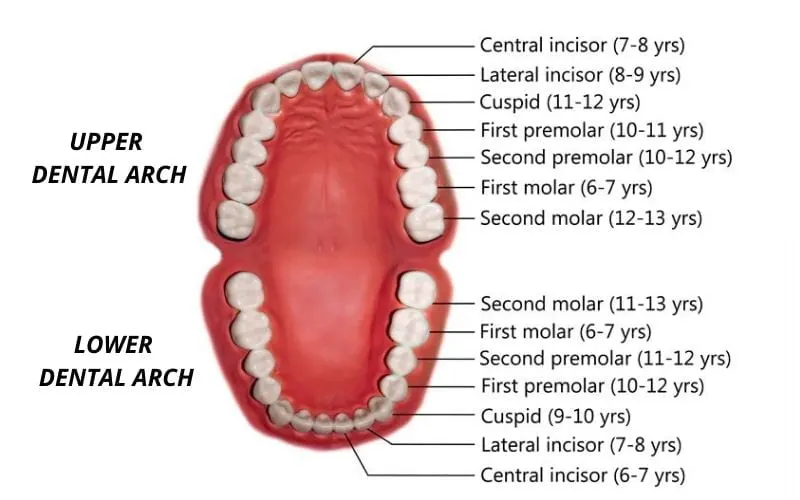
The Three Systems: A Quick Overview
|
System |
Used in |
Permanent teeth |
Primary teeth |
|---|---|---|---|
|
Universal (ADA) |
USA, Canada |
Numbers 1–32 |
Letters A–T |
|
FDI / ISO 3950 |
International (Europe, Asia, Latin America, Middle East) |
Two-digit codes 11–48 |
Two-digit codes 51–85 |
|
Palmer notation |
UK, Australia, orthodontics |
UR/UL/LR/LL + number 1–8 |
UR/UL/LR/LL + letter A–E |
Tooth Names on Tooth Chart
Teeth naming system not only provides an easy reference point for dental professionals but also helps patients understand their oral health better. It's essential to familiarize oneself with these tooth names to follow dental discussions efficiently.
Just like the numbering system, each tooth also has a designated name. Starting from the center, the two front teeth are named "Central Incisors."
Adjacent to them, on both sides, are the "Lateral Incisors."
Following the incisors are the "Canines," also known as the cuspids.
After the Canines, come the "First Premolars," then the "Second Premolars."
The next teeth are the "First Molars," "Second Molars," and finally the "Third Molars," which are commonly referred to as the wisdom teeth.
Differences between Tooth Number Charts
Universal Tooth Numbering System
The Universal Tooth Numbering System is the most commonly used system in the United States. This system assigns a unique number to each tooth in a clockwise sequence. Starting with the upper right third molar as number 1 and ending with the lower right third molar as number 32, it ensures easy identification of teeth during dental treatments. It's crucial for both patients and professionals to understand this system to enhance communication and clarity in dental procedures.
Palmer Notation System
The Palmer Notation System is used in Europe and Asia. It assigns a number to each tooth, with the first digit representing the quadrant of the mouth (1 for upper right, 2 for upper left, 3 for lower left, and 4 for lower right) and the second digit indicating the location within that quadrant.
For example, the upper left canine would be labeled as 23. This system is not as commonly used as the Universal system, but it's important for dental professionals to be familiar with both systems for effective communication.
FDI Notation System
The FDI Notation System (also known as the ISO system) is widely used in Europe and other parts of the world. It assigns a number to each tooth, with the first digit representing the quadrant of the mouth (1 for upper right, 2 for upper left, 3 for lower left, and 4 for lower right) and the second digit indicating the specific tooth within that quadrant.
For example, the upper left canine would be labeled as 23 in this system as well. This system is important for global communication in dentistry.
Which tooth chart is used where ?
ADA TOOTH NUMBERING SYSTEM: The "Universal Teeth Numbering System," also known as the "American system," is widely used in the United States. It assigns a unique number to each tooth, making it easier for dentists to communicate and identify specific teeth during dental procedures.
FDI TOOTH NUMBER SYSTEM: Canadian dentists utilize the FDI Tooth Number System, which is also recognized and used by European dentists. This system employs a two-digit numbering chart to designate each tooth, facilitating international dental communication and collaboration.
PALMER METHOD: The Palmer Method is specifically designed for orthodontists and oral surgeons. It utilizes a different tooth numbering system that involves dividing the mouth into four quadrants and labeling teeth with a combination of letters and numbers. This method aids in precise tooth identification and treatment planning for orthodontic and surgical procedures.
Complete Conversion Table: All 32 Adult Teeth
| Tooth name | Universal | FDI | Palmer |
|---|---|---|---|
| Upper right third molar (wisdom) | 1 | 18 | UR8 |
| Upper right second molar | 2 | 17 | UR7 |
| Upper right first molar | 3 | 16 | UR6 |
| Upper right second premolar | 4 | 15 | UR5 |
| Upper right first premolar | 5 | 14 | UR4 |
| Upper right canine | 6 | 13 | UR3 |
| Upper right lateral incisor | 7 | 12 | UR2 |
| Upper right central incisor | 8 | 11 | UR1 |
| Upper left central incisor | 9 | 21 | UL1 |
| Upper left lateral incisor | 10 | 22 | UL2 |
| Upper left canine | 11 | 23 | UL3 |
| Upper left first premolar | 12 | 24 | UL4 |
| Upper left second premolar | 13 | 25 | UL5 |
| Upper left first molar | 14 | 26 | UL6 |
| Upper left second molar | 15 | 27 | UL7 |
| Upper left third molar (wisdom) | 16 | 28 | UL8 |
| Lower left third molar (wisdom) | 17 | 38 | LL8 |
| Lower left second molar | 18 | 37 | LL7 |
| Lower left first molar | 19 | 36 | LL6 |
| Lower left second premolar | 20 | 35 | LL5 |
| Lower left first premolar | 21 | 34 | LL4 |
| Lower left canine | 22 | 33 | LL3 |
| Lower left lateral incisor | 23 | 32 | LL2 |
| Lower left central incisor | 24 | 31 | LL1 |
| Lower right central incisor | 25 | 41 | LR1 |
| Lower right lateral incisor | 26 | 42 | LR2 |
| Lower right canine | 27 | 43 | LR3 |
| Lower right first premolar | 28 | 44 | LR4 |
| Lower right second premolar | 29 | 45 | LR5 |
| Lower right first molar | 30 | 46 | LR6 |
| Lower right second molar | 31 | 47 | LR7 |
| Lower right third molar (wisdom) | 32 | 48 | LR8 |
Primary (Baby) Teeth Numbering
Children have 20 primary teeth — five in each quadrant. They erupt between approximately 6 months and 3 years of age and are gradually replaced by permanent teeth between ages 6 and 12 (wisdom teeth excluded).
| Tooth name | Universal | FDI | Palmer |
|---|---|---|---|
| Upper right 2nd primary molar | A | 55 | URA |
| Upper right 1st primary molar | B | 54 | URB |
| Upper right primary canine | C | 53 | URC |
| Upper right lateral incisor | D | 52 | URD |
| Upper right central incisor | E | 51 | URE |
| Upper left central incisor | F | 61 | ULE |
| Upper left lateral incisor | G | 62 | ULD |
| Upper left primary canine | H | 63 | ULC |
| Upper left 1st primary molar | I | 64 | ULB |
| Upper left 2nd primary molar | J | 65 | ULA |
| Lower left 2nd primary molar | K | 75 | LLA |
| Lower left 1st primary molar | L | 74 | LLB |
| Lower left primary canine | M | 73 | LLC |
| Lower left lateral incisor | N | 72 | LLD |
| Lower left central incisor | O | 71 | LLE |
| Lower right central incisor | P | 81 | LRE |
| Lower right lateral incisor | Q | 82 | LRD |
| Lower right primary canine | R | 83 | LRC |
| Lower right 1st primary molar | S | 84 | LRB |
| Lower right 2nd primary molar | T | 85 | LRA |
Which System Will You Encounter? A Country Guide
| Country / Region | Standard system |
|---|---|
| United States | Universal (ADA) |
| Canada | Universal (ADA) — FDI also widely used |
| United Kingdom | Palmer notation (NHS standard) |
| Ireland | Palmer notation |
| Australia | Palmer notation |
| Germany | FDI / ISO 3950 |
| France | FDI / ISO 3950 |
| Turkey | FDI / ISO 3950 |
| Spain | FDI / ISO 3950 |
| Italy | FDI / ISO 3950 |
| Middle East | FDI / ISO 3950 |
| Latin America | FDI / ISO 3950 |
| Asia | FDI / ISO 3950 |
What this means if you are receiving dental treatment abroad: Your UK dentist uses UR6 for your upper right first molar. Your Turkish dentist uses 16. Your US dentist uses tooth 3. Always confirm which system is being used when sharing dental records across countries, and ask for a plain-language description alongside any tooth number — "upper right first molar" is unambiguous in any language.
Dental Treatment Abroad: Understanding Tooth Charts
If you are contemplating receiving dental treatment abroad, rest assured that the tooth chart system ensures universal understanding among dental professionals worldwide. The More Clinics' Dentists are well-equipped and educated to understand all tooth charts, including Universal, Palmer, and FDI notation systems. This means they can efficiently identify the teeth by their numbers and names, regardless of the system used in your home country. Contact us to learn more!
FAQ Schema:
Q: How are teeth numbered in the Universal system?
A: In the Universal Numbering System (used in the US and Canada), permanent teeth are numbered 1 to 32. Numbering begins at the upper right wisdom tooth (#1), crosses the upper arch to the upper left wisdom tooth (#16), then continues from the lower left wisdom tooth (#17) to the lower right wisdom tooth (#32). Primary (baby) teeth use letters A through T in the same path.
Q: What is the difference between Universal, FDI and Palmer tooth numbering?
A: The Universal system (ADA) numbers teeth 1–32 sequentially and is used in the US and Canada. The FDI system uses two-digit codes where the first digit indicates the quadrant (1–4) and the second indicates the tooth position from the midline (1–8) — it is the international standard used in Europe, Turkey, Asia, and Latin America.
Palmer notation uses a quadrant prefix (UR, UL, LR, LL) with a number 1–8 and is the standard in the UK and Australia. The same tooth — the upper right first molar — is tooth 3 in Universal, tooth 16 in FDI, and UR6 in Palmer.
Q: What tooth number is the upper right first molar?
A: The upper right first molar is tooth 3 in the Universal system, tooth 16 in the FDI system, and UR6 in Palmer notation. It is one of the most commonly treated teeth in restorative dentistry.
Q: How do I read a dental chart if I am having treatment abroad?
A: If your dental records are from the US (Universal system), your tooth numbers will be 1–32. If travelling to Turkey or Europe for dental treatment, your provider will use the FDI two-digit system. Use the conversion table on this page to cross-reference your tooth numbers, and always ask your treating dentist for a plain-language description of each tooth alongside the clinical code.
Q: What are wisdom teeth numbers?
A: Wisdom teeth (third molars) are numbered as follows: Universal — 1 (upper right), 16 (upper left), 17 (lower left), 32 (lower right). FDI — 18 (upper right), 28 (upper left), 38 (lower left), 48 (lower right). Palmer — UR8, UL8, LL8, LR8. Not everyone develops all four wisdom teeth, and they are frequently extracted due to impaction or positioning issues.
This article provides general information and does not replace an individual medical assessment, diagnosis or treatment advice. Discuss decisions about your health and treatment with your treating clinician.