BBL vs Butt Implants: Complete 2026 Comparison — Which Is Right for You?
Talk to our team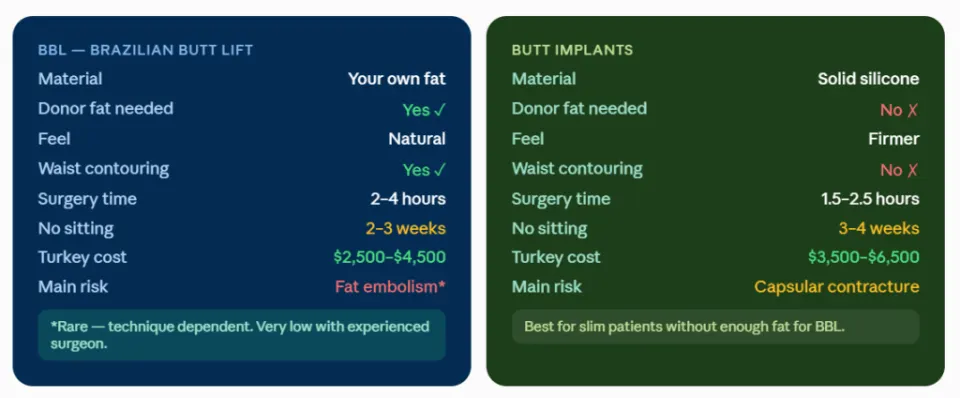
In this article 11 sections
Bbl vs butt implants: two procedures. One goal: a fuller, more projected, better-shaped buttock. But the way they get there is completely different — and the right choice depends entirely on your anatomy, your lifestyle, and what you are willing to commit to in recovery.
This guide gives you an honest, table-led comparison of every clinically significant factor: what butt implant procedure and brazilian butt lift surgery involve, who each suits, the real safety picture, what recovery looks like, what they cost, and the specific question most guides avoid answering directly — which is actually better.
The honest answer is: neither is universally better. They solve the same cosmetic goal via different mechanisms for different patient profiles. What matters is which is right for you.
The Core Difference — One Sentence Each
BBL (Brazilian Butt Lift): Uses your own fat — harvested via liposuction, processed, and injected into the buttocks. Requires sufficient donor fat. Natural feel. Simultaneously contours donor areas.
Butt Implants: Uses solid medical-grade silicone prostheses placed surgically within or beneath the gluteal muscle. No fat required. Firmer feel. Predictable volume independent of body composition.
Side-by-Side Detailed Comparison: Butt Implants vs. BBL
| Factor | BBL | Butt Implants |
|---|---|---|
| What is used | Your own fat | Solid silicone implant |
| Requires donor fat | ✅ Yes — sufficient body fat essential | ❌ No |
| Feel of result | Natural — own tissue | Firmer — implant present |
| Volume predictability | Variable — 30–70% fat survival | High — exact size chosen pre-operatively |
| Shape control | Good — injected across multiple areas | Excellent — implant defines shape directly |
| Simultaneous contouring | ✅ Yes — liposuction slims donor areas | ❌ No — only adds volume to buttocks |
| Incision / scar | Tiny liposuction access points only | Single incision in gluteal crease — concealed |
| Surgery duration | 2 – 4 hours | 1.5 – 2.5 hours |
| Anaesthesia | General | General |
| Hospital stay | 1 night | 1 night |
| No direct sitting restriction | 2 – 3 weeks | 3 – 4 weeks |
| Return to desk work | Week 2 – 3 | Week 2 – 3 |
| Full exercise return | Week 6 – 8 | Week 6 – 8 |
| Permanence | Permanent (surviving fat) | Permanent (10 – 15+ years) |
| Fat survival rate | 30 – 70% | Not applicable |
| Long-term revision risk | Low — if weight stable | Higher — capsular contracture, displacement |
| Main acute risk | Fat embolism (rare; technique-dependent) | Infection, seroma, displacement |
| Foreign body in body | ❌ No | ✅ Yes |
| Turkey cost (all-inclusive) | $2,500 – $4,500 | $3,500 – $6,500 |
| UK cost | £2,500 – £5,000 | £5,000 – £10,000 |
| USA cost | $4,000 – $8,000 | $6,000 – $12,000 |
| Best for | Patients with sufficient donor fat | Slim patients without enough fat for BBL |
Candidacy: The Most Important Factor
Who Is Right for a BBL?
The BBL is the more popular procedure globally — and for most patients with sufficient body fat, it is the better starting option. It simultaneously removes unwanted fat from donor areas (abdomen, flanks, lower back) and uses it to enhance the buttocks. The result uses your own tissue, requires no implant, and carries no long-term implant-related risks.
You are likely right for a BBL if:
- You have visible fat in the abdomen, flanks, back, or thighs that you would like reduced
- Your BMI is generally 22 or above — sufficient donor fat is typically available
- You want natural feel and a simultaneously contoured waist
- You prefer avoiding a foreign implant in your body
- You want a lower Turkey cost
BBL is not suitable if:
- You are very slim or lean — insufficient donor fat is the most common reason surgeons decline BBL requests
- You want guaranteed, predictable volume — fat survival varies between 30–70%
Who Is Right for Butt Implants?
Butt implants are the appropriate solution for the specific patient who wants meaningful buttock enhancement but does not have the body fat for a BBL. They are not the "inferior" option — they are the only option for slim patients wanting substantial enhancement.
You are likely right for butt implants if:
- You are naturally slim or lean — low body fat makes BBL impossible or result-limited
- You want predictable, specific volume — the implant size is chosen pre-operatively and delivers that volume reliably
- You want a flat or square buttock profile significantly enhanced
- You are comfortable with a longer sitting restriction and a firmer feel
Butt implants are not right if:
- You have sufficient donor fat for a BBL — in most cases, BBL produces a more natural result
- You are planning significant further weight loss — surrounding tissue changes but implant does not
The Simple Self-Assessment
Pinch test: Pinch the fat on your abdomen, flanks, or lower back firmly. Can you gather a meaningful handful of soft tissue on each side? If yes, you likely have sufficient donor fat for a BBL consultation. If your skin pulls tight against the muscle with minimal pinchable fat, butt implants are the more appropriate path.
This is a starting point only — a surgeon assessment determines candidacy accurately.
Safety: BBL vs. Butt Implants Procedure
This is the section most guides handle poorly — either dismissing BBL risks entirely or overstating implant dangers. Here is what the clinical evidence actually shows.
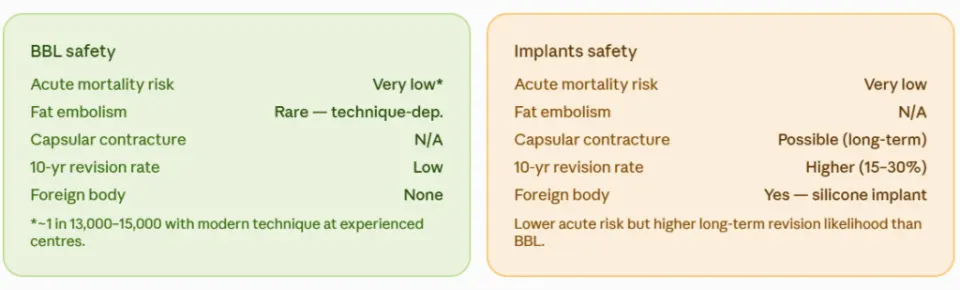
BBL Safety
The BBL has historically had the highest mortality rate of any cosmetic procedure — driven by one specific complication: fat embolism syndrome, which occurs when fat is accidentally injected into or near a gluteal blood vessel, enters the circulatory system, and reaches the lungs or heart. (Related: How safe is BBL, Risks and Complications)
The good news: this risk has been dramatically reduced by technique improvements. BBL is generally considered safer today when done with proper technique, especially with ultrasound guidance. Published mortality estimates have improved from approximately 1 in 3,000 at peak concern to approximately 1 in 13,000–15,000 with current techniques at experienced centres.
Key safety factor: The BBL's safety is almost entirely surgeon-technique dependent. In the hands of an experienced, high-volume surgeon using appropriate depth injection and ultrasound guidance, the procedure is safe. In the hands of an inexperienced operator using deep injection technique, it is not. This is the most important reason to verify your surgeon's specific BBL experience and case volume.
Other BBL risks: Seroma (fluid accumulation), uneven fat survival, contour irregularity, infection, and temporary donor-site changes are all possible but manageable at experienced centres.
Butt Implant Safety
Butt implants carry a different risk profile: lower acute mortality risk, higher long-term revision likelihood.
The acute BBL risk (fat embolism) does not apply to implants. However, implants introduce their own risk profile:
- Capsular contracture: The body forms a scar tissue capsule around the implant. In some patients this hardens and contracts, causing firmness, discomfort, or visible distortion. Requires revision if significant.
- Implant displacement: The implant can shift from its intended position — more common with subfascial than intramuscular placement. Surgical correction addresses this.
- Infection: Uncommon in accredited facilities but serious — requires implant removal and subsequent replacement.
- Seroma: Fluid accumulation around the implant in the early post-operative period.
Long-term revision rates for butt implants are meaningfully higher than for BBL — most published series report 15–30% revision rates over 10-year follow-up, compared to significantly lower rates for BBL at stable weight.
Safety Summary
| Risk category | BBL | Butt Implants |
|---|---|---|
| Acute mortality | Small but real (technique-dependent) | Very low — no fat injection |
| Fat embolism | Possible (rare with correct technique) | Not applicable |
| Capsular contracture | Not applicable | Yes — 10-year risk meaningful |
| Implant displacement | Not applicable | Possible |
| Infection | Rare | Rare — but more serious (requires removal) |
| Seroma | Possible | Possible |
| Long-term revision risk | Low (stable weight) | Higher |
| Overall acute safety | Safer with experienced surgeon | Lower acute risk |
| Overall long-term | Better (no implant-related issues) | Higher revision likelihood |
Results: What Each Produces
BBL Results
The BBL result depends on two variables: how much fat survives (30–70%), and how that fat distributes within the buttock. An experienced surgeon injects fat strategically across multiple tissue planes to maximise survival and achieve the desired shape. The result is natural in both appearance and feel — it is your own tissue and moves and feels like natural buttock tissue.
What varies:
- Fat survival — patients who maintain stable weight, sleep face-down, and avoid sitting as directed have higher survival rates
- Shape — depends on initial anatomy, donor area, and injection technique
- Longevity — surviving fat is permanent; weight fluctuation affects all fat cells, including transferred ones
Butt Implant Results
The implant result is more predictable in terms of volume — the size selected pre-operatively is what you get. Shape is also more consistent. However, the feel is firmer than natural tissue, and in very slim patients with minimal gluteal muscle and soft tissue, the implant may be more palpable.
What varies:
- Implant position over time — intramuscular placement is more stable than subfascial
- Surrounding tissue changes — weight loss or gain affects the soft tissue framing the implant
Can You Combine Both?
Yes — some patients with some donor fat but wanting maximum enhancement combine a modest BBL (using available fat) with implants to achieve volume that neither alone could provide. This is typically for patients who want a dramatic result and have moderate rather than abundant donor fat. Turkey all-inclusive cost for this combination: approximately $6,000–$9,000.
BBL vs Butt Implants Cost: Turkey vs UK vs USA
All prices in USD. UK readers: approximately £0.79 per $1.
| Procedure | 🇹🇷 Turkey (all-inclusive) | 🇬🇧 UK | 🇺🇸 USA |
|---|---|---|---|
| BBL | $2,500 – $4,500 | £2,500 – £5,000 | $4,000 – $8,000 |
| Butt Implants | $3,500 – $6,500 | £5,000 – £10,000 | $6,000 – $12,000 |
| BBL + Implants combined | $6,000 – $9,000 | £9,000 – £18,000 | $10,000 – $20,000 |
Why butt implants cost more than BBL: Implant material cost (the silicone prostheses themselves are expensive), longer operating time for pocket creation and placement, and higher long-term revision likelihood that practices factor into their pricing.
Turkey's advantage: Both procedures in Turkey are 50–70% less expensive than UK or USA equivalents when packages are compared on a genuinely all-inclusive basis. Turkey's all-inclusive packages cover surgery, anaesthesia, hospital, hotel, transfers, and follow-up — items billed separately in most Western countries.
Recovery: What's Different Between the Two
Both procedures share the defining recovery restriction: no direct sitting on the buttocks for 2–4 weeks. The mechanisms are different — BBL requires this to protect surviving fat cells before blood supply establishes; implants require it to allow the implant pocket to stabilise before the prosthesis is loaded with direct pressure.
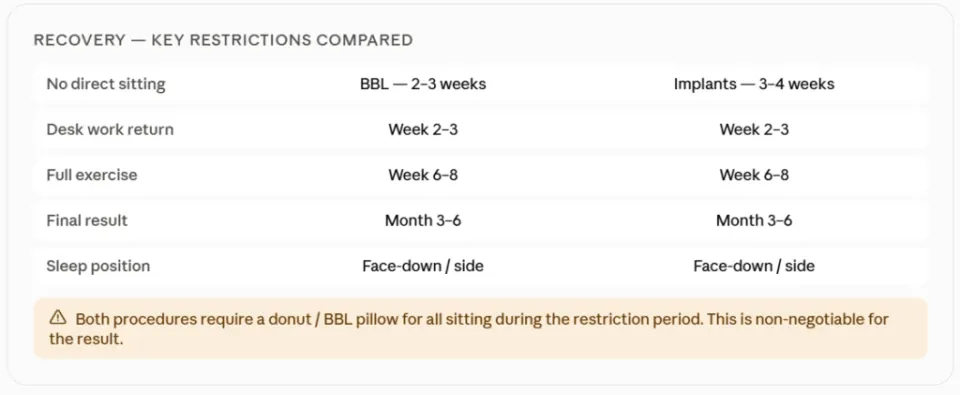
The most important thing both procedures share: Recovery compliance is not optional. For BBL, sitting on the grafted area before fat cells establish blood supply significantly reduces survival and compromises the result. For implants, direct pressure before the pocket stabilises risks displacement. In both cases, the donut or BBL pillow is essential — and patients who underestimate this restriction are the ones who end up disappointed with their results.
The Decision Framework: Which Should You Choose?
Work through these questions in order:
Question 1: Do you have sufficient donor fat? If you are lean or slim with minimal pinchable abdominal, flank, or lower back fat — butt implants. A BBL is either not possible or will produce a modest result that may not justify the procedure.
Question 2: Do you want simultaneous body contouring? If yes — BBL. The liposuction component contours your waist and other areas simultaneously. Implants only add volume to the buttocks.
Question 3: How important is natural feel? If maximum naturalness is the priority — BBL. If defined shape and predictable volume matter more than feel — either option is viable.
Question 4: How do you feel about a foreign implant? Some patients feel strongly about not having foreign material in their body permanently. For these patients, BBL is the clear preference regardless of other factors.
Question 5: What are your long-term plans? Planning significant weight loss? BBL result is affected by weight loss (fat cells in all areas reduce). Implants maintain volume but surrounding tissue changes. Neither is perfect for dramatic post-procedure weight loss.
A Note on Turkey for Both Procedures
Turkey is a popular destination for both BBL and butt implant surgery for international patients — for the same reasons: cost, surgical volume, all-inclusive logistics, and quality of care at accredited facilities.
The cost saving of 50–70% over UK and USA is real and consistent. The all-inclusive model — surgery, hospital, hotel, transfers, and aftercare in a single package — makes the comparison with fragmented Western billing more favourable still.
The critical caveat — for both procedures — is surgeon selection. For BBL, technique matters enormously for safety. For implants, placement experience determines long-term positioning stability. In both cases, verifying surgeon-specific case volume and procedural experience is more important than the clinic's general reputation or marketing.
→ See our full [BBL Turkey guide] and [Butt Implants Turkey guide] for procedure-specific detail.
Frequently Asked Questions
Is a BBL better than butt implants? Neither is universally better — they suit different patients. A BBL produces more natural results and is generally preferred when sufficient donor fat is available. Butt implants are the appropriate choice for slim patients without sufficient fat for transfer. The better procedure is whichever suits your specific anatomy and goals.
Which is safer — BBL or butt implants? Both carry risks. BBL has a small acute risk of fat embolism syndrome — significantly reduced with modern technique and experienced surgeons. Butt implants have no fat embolism risk but carry higher long-term risks including capsular contracture and implant displacement, with higher revision rates over 10-year follow-up. For most patients with appropriate surgeons, BBL is considered safer acutely; implants avoid that specific acute risk but carry more long-term maintenance requirements.
How long is recovery for BBL vs butt implants? Both share the core restriction of no direct sitting for 2–4 weeks (slightly longer for implants). Desk work return is similar at week 2–3 for both. Full exercise return is week 6–8 for both. The recovery timelines are broadly comparable — the main difference is that BBL involves soreness at multiple liposuction donor sites in addition to the buttocks.
Can you get both BBL and butt implants? Yes — a combination approach uses available fat around or adjacent to implants to enhance shape and softness. This is typically for patients who want dramatic results and have moderate but insufficient fat for BBL alone. Turkey all-inclusive packages for the combination typically cost $6,000–$9,000.
Why is BBL cheaper than butt implants? The implant material itself adds significant cost. BBL uses your own fat, which costs nothing as a material — the cost is the surgical time and liposuction technique. Solid silicone gluteal implants carry a material cost that BBL does not. Operating time is also typically longer for implant placement than for fat transfer.
Does BBL look more natural than butt implants? In most cases, yes — because it is your own tissue. BBL results move and feel like natural buttock tissue. Implants produce a slightly firmer feel and in slim patients with minimal soft tissue coverage may be more palpable. Both can look natural from the outside with experienced surgical technique.
How much does BBL vs butt implants cost in Turkey? BBL in Turkey costs $2,500–$4,500 all-inclusive in 2026. Butt implants cost $3,500–$6,500 all-inclusive. Both packages cover surgery, anaesthesia, hospital, hotel (6–7 nights), transfers, compression garment, and follow-up. UK comparison: BBL £2,500–£5,000 vs implants £5,000–£10,000 (procedure only).
The Last Word from The More Clinics
The BBL vs butt implants decision is ultimately an anatomy question more than a preference question. For most patients with sufficient donor fat, a BBL is the better starting point — more natural, lower long-term revision risk, and simultaneous body contouring. For slim patients without sufficient fat, butt implants are not a compromise — they are the right procedure.
At The More Clinics, every patient requesting buttock enhancement begins with an anatomy assessment — photographs, measurements, body composition discussion — so the recommendation is based on your specific situation, not a default preference. If a BBL is not feasible for you, we will tell you that. If implants are the right choice, we explain why and match you with a surgeon with specific gluteal augmentation experience.
A free consultation takes fifteen minutes and gives you a specific procedure recommendation, realistic outcome expectation, and transparent all-inclusive cost.
Book a Free Consultation → WhatsApp Us →
Medical disclaimer: This article is for informational and educational purposes only. Both BBL and butt implant surgery carry risks that vary based on individual health, anatomy, and surgeon technique. Consult a board-certified plastic surgeon for assessment specific to your circumstances.
This article provides general information and does not replace an individual medical assessment, diagnosis or treatment advice. Discuss decisions about your health and treatment with your treating clinician.